


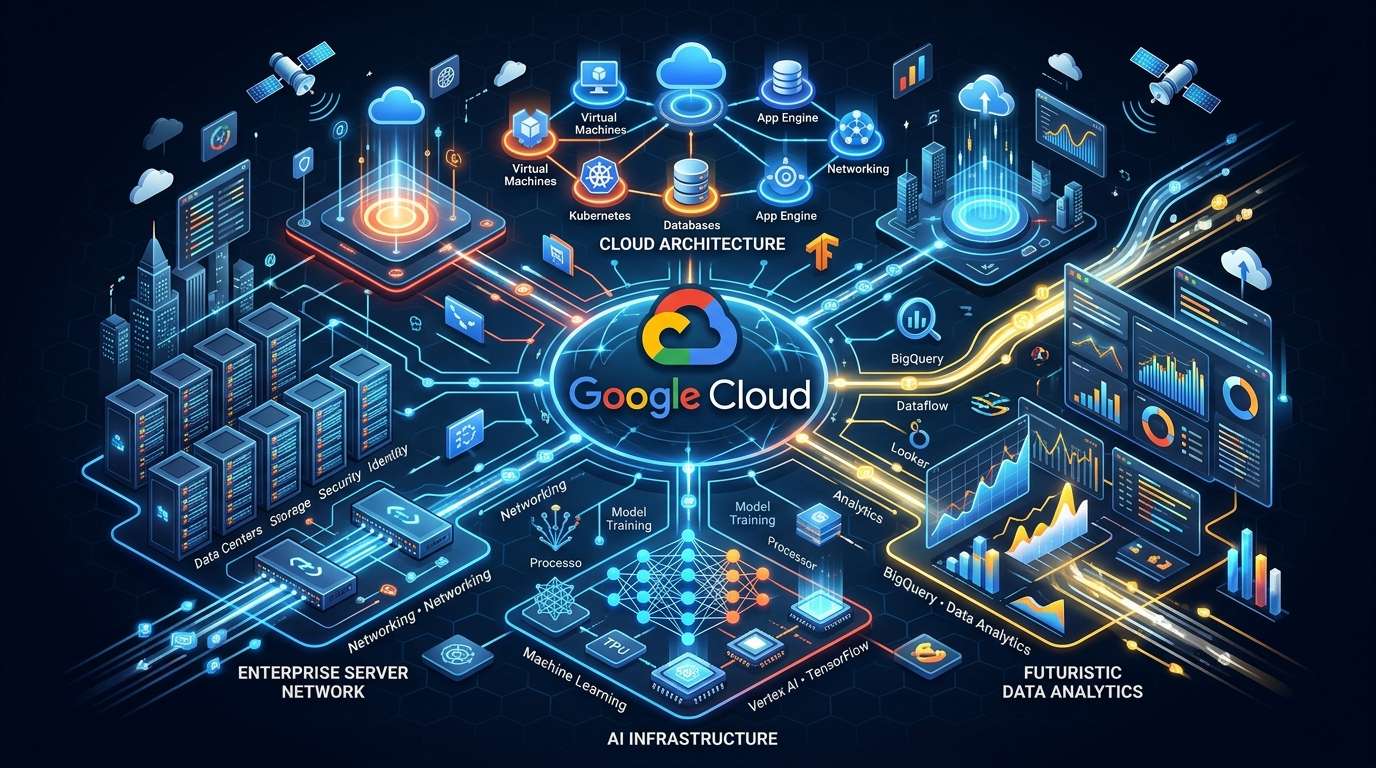
Discover how Google Cloud Platform (GCP) delivers hyperscale
computing, AI-driven analytics, and enterprise Kubernetes to accelerate digital transformation and optimize
modern business workloads.
1. What Are Google Cloud Services (GCP)?
Google Cloud Services (commonly known as Google Cloud
Platform or GCP) is a suite of modular cloud computing services provided by
Google. Built on the identical ultra-scalable, high-speed infrastructure that powers Google Search, YouTube, and
Gmail, Google Cloud provides enterprises with reliable hosting, massive data processing, machine learning
frameworks, and robust security management.
As modern organizations transition away from legacy data centers, GCP has emerged as
an industry-leading public cloud provider, offering businesses flexible Infrastructure-as-a-Service (IaaS),
Platform-as-a-Service (PaaS), and Serverless computing models.
2. Core Google Cloud Services Pillars
Google Cloud organizes its comprehensive offerings into distinct pillars engineered
to support enterprise workloads at every scale:
|
Compute &
Virtualization High-performance virtual machines,
container management, and serverless compute tailored for scalable applications. |
Storage &
Databases Highly durable object storage,
managed SQL, and globally distributed transactional databases like Cloud Spanner. |
|
Big Data &
Analytics Serverless data warehousing with
Google BigQuery, stream processing with Dataflow, and real-time insights with Looker. |
Vertex AI &
ML Enterprise-grade AI platforms,
pre-trained machine learning APIs, AutoML, and custom generative AI model training. |
3. Compute & Modern Containerization
At the center of Google Cloud’s infrastructure are versatile compute solutions that
allow developers to deploy applications without operational friction:
Google Compute Engine (GCE): Configurable, high-speed Virtual Machines (VMs) running on
Google’s worldwide fiber-optic network with custom CPU and memory configurations.
Google Kubernetes Engine (GKE): The gold standard for managed container orchestration with
native autoscaling, automated node upgrades, and multi-cluster support.
Cloud Run: Fully managed serverless container runtime that enables developers to run stateless
HTTP containers instantly without provisioning servers.
Google App Engine: Fully managed PaaS platform for deploying scalable web applications in
Python, Node.js, Java, Go, and PHP.
Kubernetes Leadership
the Cloud Native Computing Foundation (CNCF). Deploying your container workloads on Google
Kubernetes Engine (GKE) delivers native optimization, automated node upgrades, and seamless
hybrid management via Google Anthos.
4. Big Data Analytics & Artificial Intelligence
Data analytics and AI are the flagship differentiators of Google Cloud
Services. With petabyte-scale analysis and integrated intelligence, GCP empowers data teams to
transform raw datasets into real-time business decisions.
Serverless Enterprise Data Warehouse
BigQuery is a
completely serverless, multi-cloud enterprise data warehouse designed for business agility. It allows
organizations to query massive datasets using standard SQL in seconds, without manual index creation or
cluster maintenance. With built-in BigQuery ML, data analysts can build and operationalize machine learning
models directly inside SQL.
Foundation Models
Google Cloud Vertex AI
provides an end-to-end unified MLOps platform where developers and data scientists train, deploy, and scale
machine learning and generative AI models. With direct access to state-of-the-art foundation models like
Gemini, teams can build generative search, intelligent chatbots, and enterprise-grade recommendation
engines.
5. Cloud Storage and Database Capabilities
Google Cloud provides dependable, multi-region storage systems designed with
99.999999999% (11 9s) annual durability:
Google Cloud Storage: Unified object storage across Standard, Nearline, Coldline, and Archive
tiers for cost optimization.
Cloud SQL: Fully managed relational database service for MySQL, PostgreSQL, and SQL Server with
automated backups and replication.
Cloud Spanner: The first enterprise-grade, globally distributed, strongly consistent database
service combining relational features with non-relational scale.
Cloud Firestore / Datastore: Flexible, scalable NoSQL document databases for mobile, web, and
server development.
6. Enterprise Security, Cloud IAM & Global Networking
Google’s proprietary private network connects over 40 regions and 120+ availability
zones across the globe through private undersea cables, reducing public internet latency and elevating security
standards.
Cloud Identity and Access Management (IAM): Fine-grained permission controls, least-privilege
automation, and context-aware access policies.
Google Cloud Armor: Enterprise DDoS defense and Web Application Firewall (WAF) leveraging
perimeter defenses protecting Google Search.
Confidential Computing: Groundbreaking encryption technology that encrypts sensitive
data-in-use while being processed in memory.
7. Google Cloud vs AWS vs Microsoft Azure
Selecting the right cloud provider is vital for long-term ROI. Here is how Google
Cloud stands out against competitors:
| Feature / Capability | Google Cloud (GCP) | Amazon Web Services (AWS) | Microsoft Azure |
|---|---|---|---|
| Container Orchestration | Industry-Leading GKE | Amazon EKS / ECS | Azure AKS |
| Data Analytics | BigQuery (Instant SQL ML) | Amazon Redshift | Azure Synapse |
| AI & Machine Learning | Vertex AI & Gemini Models | Amazon SageMaker | Azure OpenAI |
| Global Backbone Network | Tier-1 Private Fiber | Mixed Transit Backbone | Microsoft Global Network |
| Pricing Flexibility | Automatic Sustained-Use | Savings Plans / Reserved | Reserved Instances |
8. Strategic Benefits of Google Cloud Migration
Migrating enterprise workloads to Google Cloud delivers measurable technical and
financial advantages:
Transparent Cost Savings: Automatic sustained-use discounts, per-second billing, and custom
machine sizing eliminate infrastructure waste.
Open Cloud & Portability: Native support for open-source frameworks (Kubernetes, TensorFlow,
Istio) prevents vendor lock-in.
Carbon-Neutral Operations: Google Cloud matches 100% of its global electricity consumption with
renewable energy for cleaner operations.
9. Frequently Asked Questions (FAQs)
popular Google Cloud Services?
Google Compute Engine (GCE), Google Kubernetes Engine (GKE), BigQuery, Google Cloud Storage, Cloud Run, and
Vertex AI.
Cloud over other cloud providers?
data and analytics capabilities (BigQuery), state-of-the-art AI infrastructure (Vertex AI), unmatched
Kubernetes integration (GKE), and global private network speed.
suitable for small businesses and startups?
$300 in new customer credits, automated billing optimization, and flexible pay-as-you-go pricing that
accommodates organizations of any scale.
Google Cloud Platform.